
What is the Difference Between a Nutritionist and a Registered Dietitian Nutritionist?
Written by Stephanie White, Dietetic Intern
If you’ve ever searched for nutrition advice, you’ve probably come across terms like nutritionist, dietitian or and registered dietitian. They sound similar but they are not always the same. Understanding the difference can help you choose a qualified professional for your health needs.
In this article, we’ll explain the training and scope of practice of Registered Dietitian Nutritionists and also highlight the role of Certified Nutrition Specialists (CNS), another advanced nutrition credential.

What Is a Registered Dietitian Nutritionist (RDN)?
A Registered Dietitian Nutritionist (RDN) is a nationally credentialed food and nutrition expert. The credential is awarded by the Commission on Dietetic Registration, the credentialing agency for the Academy of Nutrition and Dietetics.
To become an RDN, an individual must:
Complete an accredited bachelor’s and master’s degree with a didactic program in nutrition and dietetics
Finish a supervised practice program (dietetic internship) with at least 1,000 hours of hands-on training
Pass a national registration exam
Maintain continuing education requirements
Be licensed or certified in many states (depending on state law)
Before we continue, one term that is important to understand is “scope of practice” which defines the legal, professional, and ethical boundaries of a healthcare provider's role, outlining the specific procedures, actions, and services they are educated and licensed to perform. This is important to understand when receiving healthcare from any discipline.
“Scope of practice refers to those activities that a person licensed to practice as a health professional is permitted to perform, which is increasingly determined by statutes enacted by state legislatures and by rules adopted by the appropriate licensing entity. ”
Registered Dietitian Nutritionists are permitted to perform:
Medical Nutrition Therapy (MNT) – assessing nutrition status, interpreting clinical data and lab markers, and developing individualized nutrition interventions for medical conditions.
Clinical nutrition care – including nutrition-focused physical exams, food–drug interaction management, and specialized nutrition support such as enteral and parenteral nutrition.
Preventive and lifestyle nutrition – supporting chronic disease prevention, metabolic health, prenatal and pediatric nutrition, sports nutrition, relationship with food and general wellness.
Community and public health nutrition – developing and implementing programs that improve population health and nutrition access.
Corporate wellness and education – creating workplace wellness programs, nutrition education initiatives, and health promotion strategies.
Food service and food systems management – overseeing menu planning, therapeutic diets, food safety, and large-scale food service operations in healthcare and community settings.
Research, policy, and professional practice – contributing to nutrition research, clinical guidelines, public health policy, and professional education.
RDNs are qualified to provide evidence-based nutrition care in hospitals, dialysis centers, health clinics, school districts, professional sports teams, long-term care facilities, outpatient practices, research teams, and public health settings (just to name a few). Because of their medical training, RDNs are recognized by Medicare, Medicaid and commercial insurance companies as healthcare providers.
What is a Certified Nutrition Specialist?
The Certified Nutrition Specialist (CNS) is a nationally recognized credential issued by the Board for Certification of Nutrition Specialists (BCNS). Scope of practice for CNS practitioners depends on the state where they are practicing, as nutrition licensure laws vary across the United States.
CNS professionals complete advanced graduate-level education in nutrition, supervised practice hours, a certification exam, and ongoing continuing education to maintain their credential.
Training pathways for nutrition professionals can differ. Registered Dietitian Nutritionist (RDN) training traditionally emphasizes clinical nutrition and medical nutrition therapy within healthcare systems, while CNS training often emphasizes advanced nutrition science and may be more common in integrative or functional nutrition settings.
However, there is significant overlap between the two credentials. Many RDNs practice integrative or functional nutrition, and some CNS practitioners work in clinical settings and provide nutrition therapy depending on state laws and licensure requirements.
With the growing burden of chronic disease and widespread nutrition misinformation, many experts recognize the need for well-trained nutrition professionals across different specialties. Collaboration between Certified Nutrition Specialists and Registered Dietitian Nutritions can help expand access to evidence-based nutrition education and care.
What is a Nutritionist?
The answer depends on which state you live in.
In many states, the title “nutritionist” is not regulated
Education & training requirements vary widely
There may be no standardized exam or supervised clinical experience
Some nutritionists do have formal education in nutrition science, but the title alone does not guarantee specific credentials or medical training. Certain states regulate who can use the term, but in many areas, it remains unprotected. That is why it is important to ask about credentials when seeking nutrition advice.
Health coaches may also be part of a client’s care team, often supporting behavior change, accountability, and implementation of nutrition interventions. In many cases, they help clients follow through on a nutrition care plan developed by a Registered Dietitian Nutritionist. While both roles are valuable, they serve different functions, with RDNs providing clinical nutrition assessment and medical nutrition therapy.
Why do some Dietitians use “Registered Dietitian” and some “Registered Dietitian Nutritionist” ?
You may notice that some professionals use RD and others use RDN. These credentials are identical in terms of education, training, and scope of practice.
In 2013, the Academy of Nutrition and Dietetics formally adopted the optional “Nutritionist” designation to the RD credential. The change was made to:
Clarify that dietitians are also nutrition experts
Increase public recognition of the term “nutritionist”
Distinguish credentialed professionals from unregulated use of the title
RDs and an RDNs have the same credential and same qualifications. The additional “N” simply reflects the profession’s full scope in nutrition science and medical care.
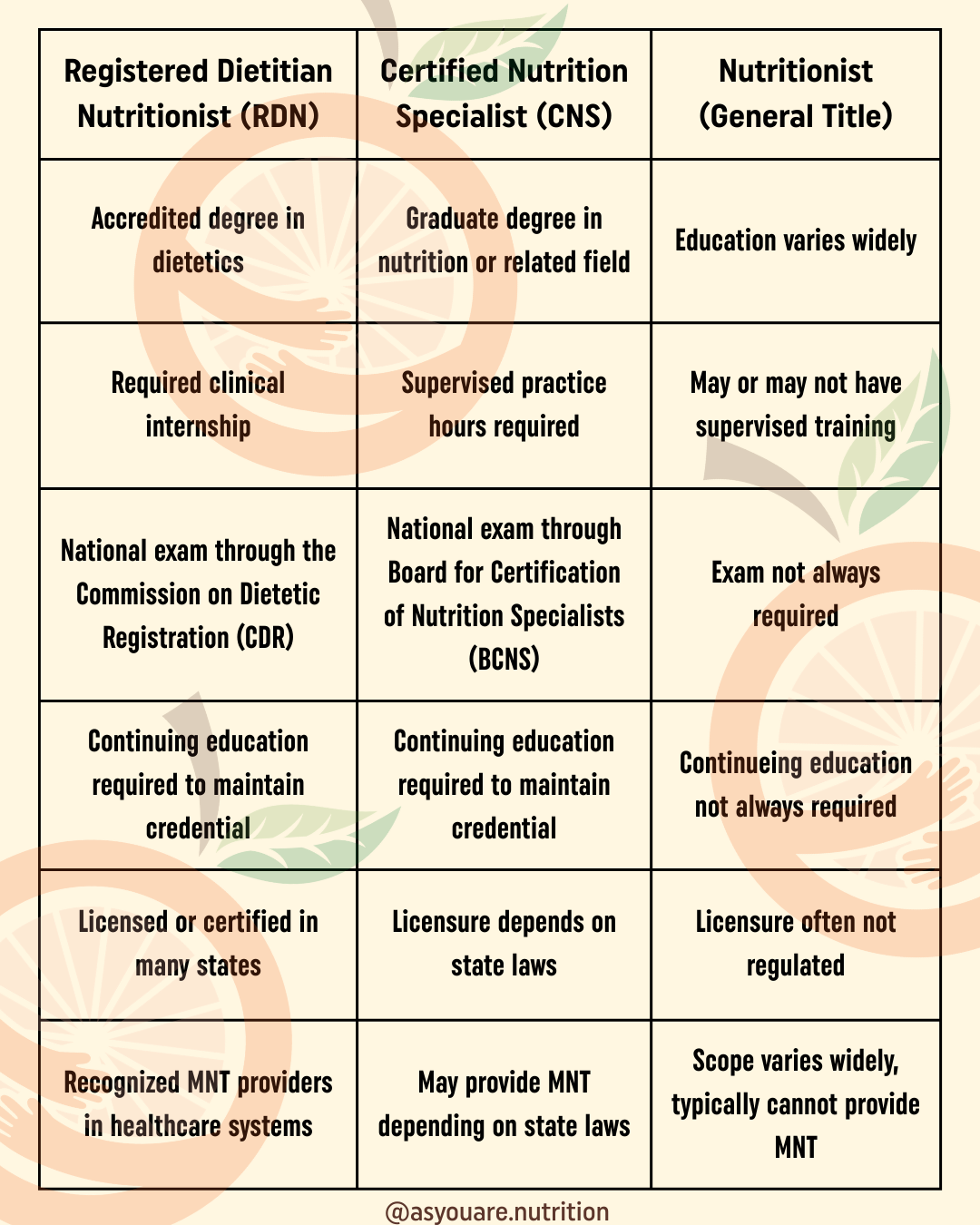
Dietitian vs Nutritionist vs Certified Nutrition Specialist: Education and Training Comparison
Nutrition Practice Laws in California: Scope of Practice, Licensure, and MNT
California law makes an important distinction between general nutrition advice and Medical Nutrition Therapy (MNT). Understanding this difference can help individuals choose a qualified provider for their health needs.
General Nutrition Advice in California
Under California Business and Professions Code §2068, any individual may provide general nutrition information or wellness guidance.
However, when someone offers nutrition services commercially using the title “nutritionist,” they must clearly disclose that:
They are not licensed by the state of California
Their services do not include diagnosing, treating, or curing disease
Because of this law, the title “nutritionist” is not restricted in California, meaning individuals may use the term regardless of their level of education or professional credentialing.
Protected Titles: Dietitian and Registered Dietitian Nutritionist
California law does protect certain professional titles.
Under California Business and Professions Code §2585, the following titles are legally restricted:
Registered Dietitian (RD)
Registered Dietitian Nutritionist (RDN)
Dietitian
Only professionals who hold the national credential awarded by the Commission on Dietetic Registration may legally use these titles.
Medical Nutrition Therapy (MNT) in California
Medical Nutrition Therapy goes beyond general nutrition advice.
MNT involves:
Nutrition assessment
Diagnosis of nutrition-related problems
Clinical nutrition treatment for medical conditions
Importantly, in California, MNT requires a referral from a licensed healthcare provider. Examples of conditions that may require MNT include diabetes, kidney disease, gastrointestinal disorders, and malnutrition. In this new landscape of telehealth, this state law applies to if the client is in California, not where the dietitian is.
California statutes describing these disease-focused nutrition services primarily reference Registered Dietitian Nutritionists, along with certain master’s-level nutrition professionals defined in the law (BPC §2586).
Why This Matters
Because of these legal distinctions, individuals seeking nutrition care for medical conditions should look for a Registered Dietitian Nutritionist (RDN) or another appropriately qualified healthcare professional.
Doing so helps ensure the care they receive is evidence-based, clinically appropriate, and recognized within California healthcare law.
Additional Specialized Training
Some areas of nutrition require advanced clinical training beyond standard RDN education. Conditions such as eating disorders, diabetes, and sports performance nutrition often involve complex medical and metabolic considerations.
Registered Dietitian Nutritionists who work in these specialized areas may pursue additional certifications and supervised experience to ensure care is safe, evidence-based, and effective. Examples of advanced credentials include:
Certified Eating Disorders Registered Dietitian (CEDRD) or CEDRD-S
Certified Diabetes Care and Education Specialist (CDCES)
Certified Specialist in Sports Dietetics (CSSD)
Integrative & Functional Nutrition Certified Practitioner (IFNCP)
Many of these titles are a board-certified credentials and indicate that the RDN has completed focused training in high-risk or specialized populations, although general nutrition care does not require these certifications.
When Should You See a Registered Dietitian Nutritionist (RDN)?
Knowing when to seek a Registered Dietitian Nutritionist can help ensure your nutrition care is clinically appropriate.
Situations Where an RDN Is Recommended
You should consider seeing a Registered Dietitian Nutritionist if you have:
Chronic medical conditions – diabetes, kidney disease, heart disease, metabolic syndrome
Gastrointestinal disorders – Irritable Bowel Syndrome (IBS), Irritable Bowel Disease (IBD), celiac disease, acid reflux, malabsorption
Liver disease – NAFLD, cirrhosis, or post-liver transplant nutrition
Cancer or oncology-related nutrition support – during treatment or recovery
Malnutrition or unintentional weight changes
Food allergies or intolerances – requiring individualized meal planning
Post-surgical nutrition needs
Prenatal or postnatal nutrition support – to optimize maternal and fetal health
Feeding difficulties in children – picky or selective eating, growth concerns
Sports performance or high physical activity needs – fueling, recovery, body composition management
Endocrine and hormonal conditions – PCOS, thyroid disorders, insulin resistance
Hyperlipidemia or hypertension – managing cholesterol, triglycerides, or blood pressure through diet
Micronutrient deficiencies – iron, vitamin D, B12, or other nutrient optimization
Eating disorders – medically supervised refeeding and nutrition risk management
Specialized clinical nutrition – chemotherapy, medications, or chronic conditions
In these cases, you may benefit from Medical Nutrition Therapy (MNT), which involves assessment, diagnosis, and clinical nutrition treatment for medical conditions. Dietitians do far more than review general guidelines or the “plate method”; they assess medical history, lab markers, medications, and metabolic needs to create personalized nutrition plans.
*In California, MNT requires a referral from a licensed healthcare provider. This ensures your nutrition care is legally recognized, safe, and tailored to your medical needs.

Situations Where General Nutrition Advice Is Appropriate
For general wellness, lifestyle changes, or meal planning without underlying medical conditions, a nutritionist or other qualified professional may provide guidance.
However, it’s still important to verify credentials and training, especially if your nutrition needs go beyond general wellness.
Choosing a provider with:
The RDN credential (or CNS credential)
State licensure (if required)
Advanced specialty training (CEDRD, CSSD, CDCES etc.)
Interdisciplinary collaboration experience
ensures safe, ethical, and evidence-based care.
The Bottom Line
While both Nutritionists and Registered Dietitian Nutritionists work in the field of nutrition, the key difference lies in education, regulation, and scope of practice. Registered Dietitian Nutritionists have advanced clinical judgment, medical knowledge, and specialized training that go beyond general nutrition advice. Registered Dietitian Nutritionists with additional credentials and supervised experience are equipped to provide comprehensive, individualized, and medically appropriate care.